
SUCo-SA and SATTA Member Update CITES Animals Committee (AC34) Part 1

CITES Animals Committee (AC34) – Geneva, Switzerland
Week 1 Report
The 34th meeting of the CITES Animals Committee (AC34) officially opened in Geneva, Switzerland, bringing together almost 500 delegates from 73 Parties (governments) and 79 observer organisations.
The Committee plays a critical role in providing scientific and technical advice to CITES and often lays the groundwork for future decisions that are eventually adopted by the Conference of the Parties (CoP).
This year’s meeting is chaired by Dr Amir Hamidy (Indonesia), who becomes the first Chair of the Animals Committee from the Asian region, with Dr Thomas Leuteritz (USA) elected as Vice-Chair.
SUCo-SA and SATTA are represented at the meeting to ensure that the interests of South Africa’s sustainable wildlife economy, including wildlife ranching, professional hunting, taxidermy and associated industries, are properly represented during these important technical discussions.
Major agenda items
The Committee’s agenda is extensive, with more than 50 items covering issues that directly affect Southern Africa’s wildlife industry. Topics include:
- African lion conservation and Appendix-I quota reviews
- Big cats
- Giraffe
- Crocodilians
- Sharks and rays, including recently listed deep-water shark species
- Vultures
- Amphibians
- Captive breeding and ranching standards
- Review of Significant Trade
- Taxonomic (nomenclature) changes
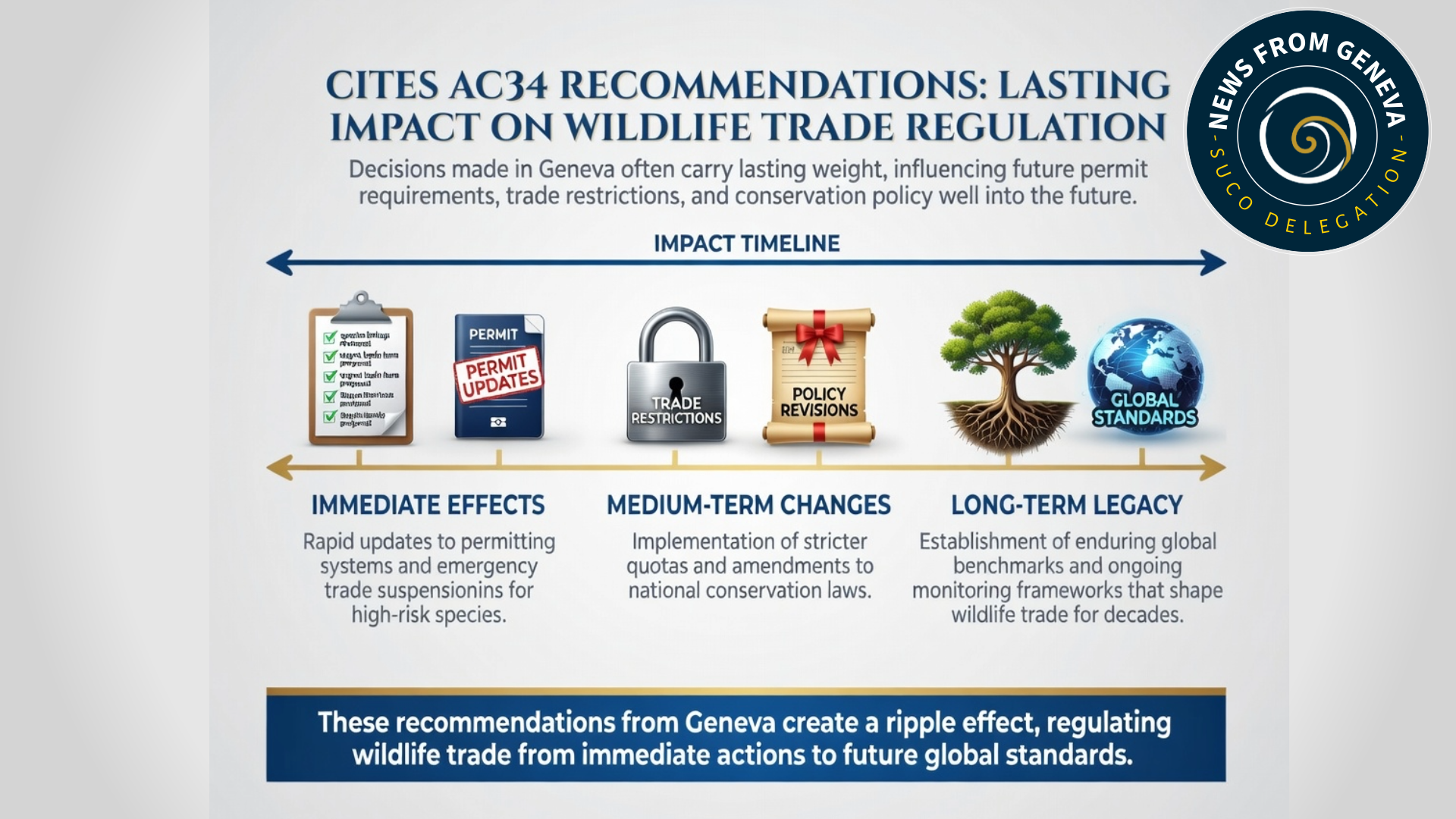
Although many of these discussions are highly technical, the recommendations made by the Animals Committee frequently influence future permit requirements, trade restrictions and conservation policy.

South Africa defends science-based decision making
One of the most important discussions during the opening sessions concerned the Review of Captive-produced Specimens.
South Africa raised an important procedural concern regarding the proposal to include additional species for review based on supplementary information documents rather than the formal scientific analysis.
South Africa argued that species should only be selected where they meet the agreed scientific criteria established by the Committee. China and Mexico immediately supported this position.
Mexico summed up the concern by stating:
“We would not support any additional species included from that information document — otherwise why undertake the analysis in the first place.”
This intervention reinforces an important principle that SUCo-SA has consistently supported:
CITES decisions must remain science-based, transparent and evidence-driven rather than expanding beyond the agreed analytical process.
Strong support from the United States
The United States Department of the Interior delivered one of the strongest statements supporting sustainable use during the meeting.
The USA emphasised that the Animals Committee should continue to focus on:
- science-based Non-Detriment Findings;
- legal, well-regulated wildlife trade;
- case-by-case assessment of captive breeding operations;
- recognising legitimate captive breeding and ranching operations;
- avoiding blanket restrictions against compliant operators;
- supporting range states through workable permitting and monitoring systems.
These principles closely align with the long-standing position of SUCo-SA that sustainable wildlife use, hunting and wildlife ranching are essential conservation tools that generate funding for habitat conservation while supporting rural communities and reducing incentives for illegal wildlife trade.
Captive-produced and ranched specimens
A significant amount of time was devoted to reviewing species traded as captive-produced or ranched.
The Committee established an in-session Working Group to determine which species and country combinations require further review.
The analysis produced the following results:
| Selection Criterion | Species Selected |
| Significant increase in trade | 139 species |
| Significant trade volumes | Included within above |
| Shifts in source codes | Included within above |
| Reporting inconsistencies | 11 species |
| Incorrect source codes | Included above |
| Legal acquisition concerns | 66 species |
| Difficult to breed (reptiles & amphibians) | 51 species |
| Total | 243 species involving 400 species/country combinations |
For Southern Africa, species receiving particular attention included:
- Giraffe (Giraffa camelopardalis)
- African Elephant (Loxodonta africana)
- Nile Crocodile (Crocodylus niloticus)
- African Lion (Panthera leo)
- Cheetah (Acinonyx jubatus)
- Lechwe (Kobus leche)
- Tiger (Panthera tigris) (South African captive populations)
- Approximately twenty parrot species associated with South African breeding facilities.
It is important to understand that inclusion on these review lists is not intended as a punishment. However, if serious concerns remain unresolved following review, CITES can recommend temporary trade suspensions. Consequently, every Party seeks to avoid unnecessary inclusion.