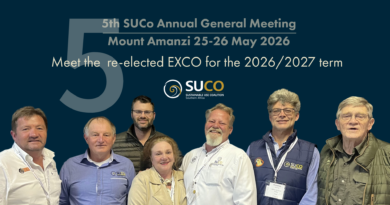

SUCo-SA Forge the Future of Conservation That Works – AGM 2026
The esteemed leaders of South Africa’s sustainable private sector wildlife industry met at Mount Amanzi in Hartbeespoort for the Southern African Sustainable Use Coalition (SUCo-SA)’s annual general meeting this week.
While the AGM took place on Tuesday , it was preceded by a workshop on Monday 26 May.
The day started with Dr Herman “Krappies” Els, Additional Exco member of SUCo-SA, setting the scene by expanding on the impact of human-wildlife conflict on both poor rural farmers and wildlife across the continent.
Dr Els explained that such conflict is often the result of misguided philanthropic or conservation efforts. For instance, when elephants are rewilded into areas where subsistence farmers depend on small-scale agriculture to feed their families, a single elephant can destroy an entire field – and with it, a family’s livelihood – in one evening.
In retaliation, communities may kill the elephant, a reality that is neither simple nor pleasant to witness.
“We need to understand that wild animals are killed to protect human livelihoods,” Dr Els emphasized.
He pointed to similar examples, including lions killing cattle and ongoing baboon-related conflict in the Southern Cape.
Richard York, Secretary-General of SUCo-SA, led the next session, during which a SWOT analysis of SUCo-SA was undertaken to assess the organisation’s strengths, weaknesses, opportunities and threats, and to help guide future strategy and planning.
Susan Swart, SUCo-SA’s Administration & Operations, followed with a session on communication strategies aimed at minimising misinformation and strengthening clear, consistent communication with relevant stakeholders and the broader public.
After this Stephen Palos, SUCo-SA’s vice chairperson, said SUCo’s advocacy and lobbying efforts must become more strategic, coordinated and results-driven. He emphasised that while marketing builds awareness and communication ensures clear messaging, advocacy shapes public opinion and lobbying influences decision-makers and policy. Palos argued that access to officials and forums alone is not success — real success is measured through improved laws, policies and implementation.
Hannes Wessels, SUCo-SA’s treasurer, emphasized the fact that the coalition’s long-term success depends on financial sustainability. He explained that secure funding strengthens advocacy, communication and conservation impact, while weak funding limits influence and growth. Wessels encouraged the organisation to pursue diverse income streams — including sponsorships, partnerships and fundraising campaigns — and stressed that trust, transparency and visible results are essential to securing long-term support.
Antonie Meiring, SUCo-SA exco member, highlighted the organisation’s role in ensuring representation at key international policy platforms. A major focus of his discussion was the importance of engagement with the Convention on International Trade in Endangered Species of Wild Fauna and Flora (CITES), the international agreement regulating trade in wildlife and wildlife products to ensure species survival.
Meiring further noted the importance of related international conservation processes such as the Convention on the Conservation of Migratory Species of Wild Animals (CMS) and the Convention on Biological Diversity (CBD).
Pieter Swart, re-elected as Chairman of SUCo-SA for the next three years, embodies exceptional leadership and vision for the future.
His steady hand has provided much-needed stability to the organisation during some challenging times, making him a valuable asset whose integrity and steadfastness continue to inspire confidence across the sustainable-use wildlife sector.
Respected by peers and stakeholders alike, Pieter Swart is a leader to be trusted — someone who consistently guides SUCo-SA with principle, clarity, and an unwavering commitment to balanced conservation that works for both people and wildlife.